Programme Highlights
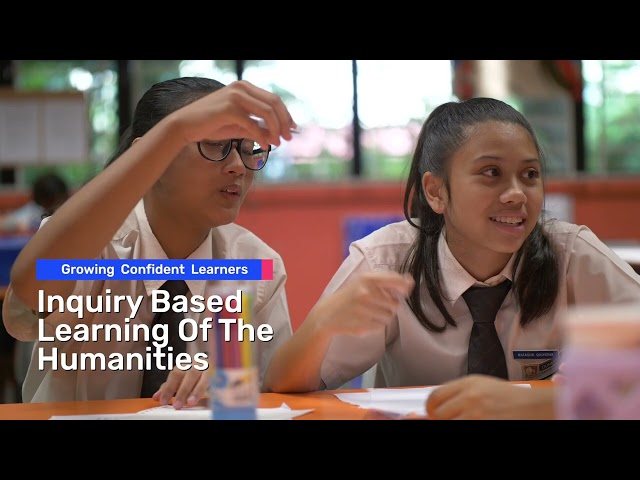
Explore what Dunman Secondary School has to offer at Open House 2026, from guided tours and STEM activities to CCA performances and a talk by our Principal.
Open House 2026
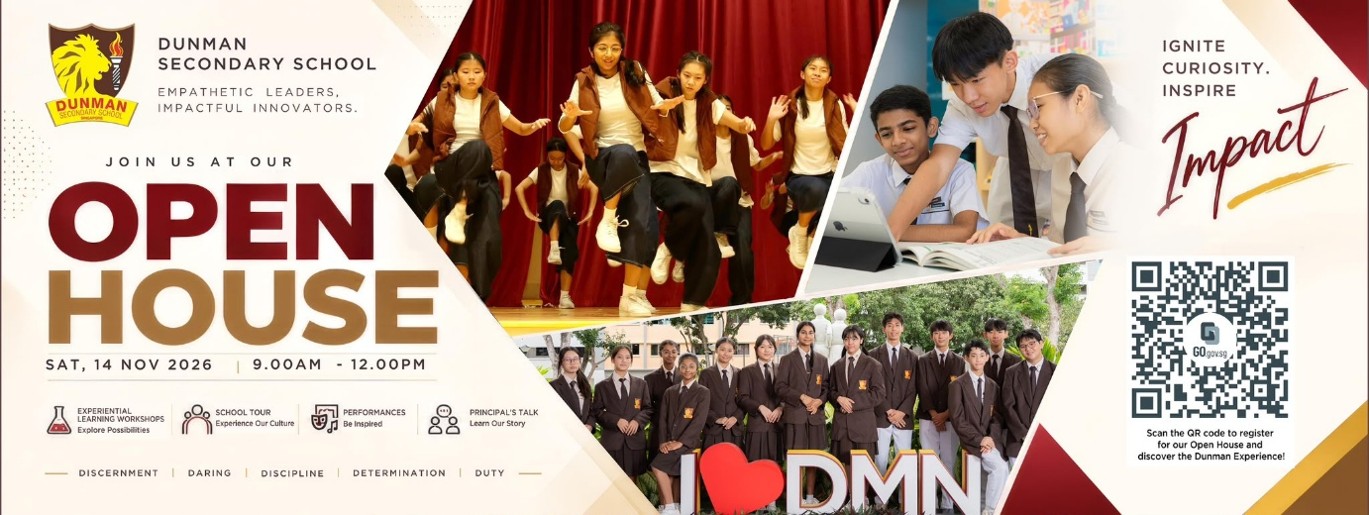
Click on the button below to register for our Open House and discover the Dunman Experience!
Programme Highlights
STEM Experiential Learning Workshops
School Guided Tour
Talk by School Principal, Mr Toh Thiam Chye
CCA Performances and Roadshow
Programme schedule with times and events
Time | Event |
|---|---|
0900 to 1015 | STEM Experiential Learning Workshops |
1030 to 1055 | CCA Performances in MPH |
1055 to 1130 | Introduction by Principal, Mr Toh Thiam Chye |
Note:
CCA Roadshow Schedule and Guided School Tour
Time | Event |
|---|---|
0900 to 1200 | CCA Roadshow (Ongoing) |
0900 to 1200 | Guided School Tour (Ongoing) |
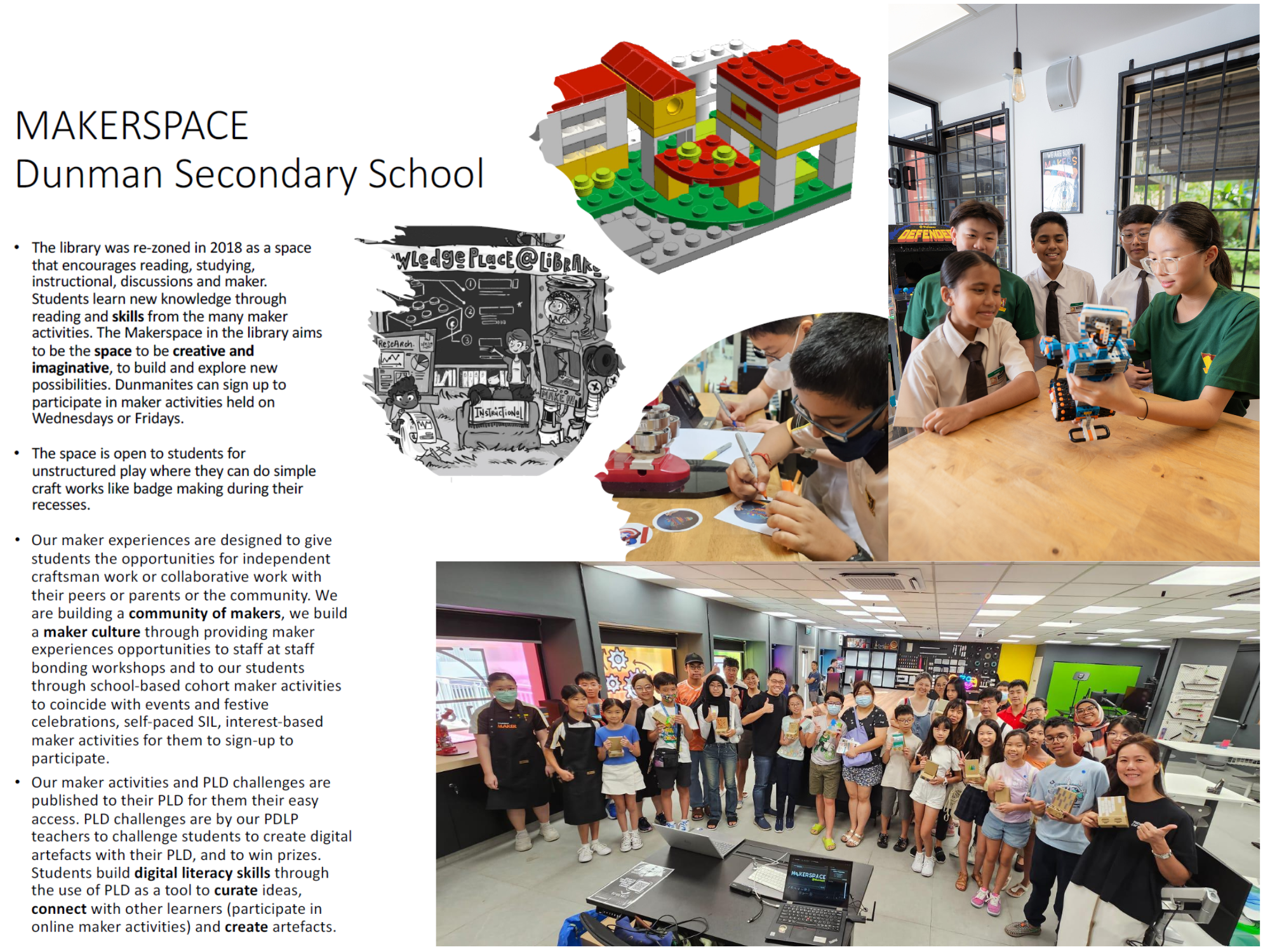
Explore creativity, innovation and hands on learning at Dunman Secondary School’s Makerspace
Frequently Asked Questions
1. How do the students select their CCA and what are the CCAs offered in Dunman Secondary School?
Dunmanites are required to take up a CCA from one of the core CCAs offered in Dunman.
In Secondary One, the school will organise performing arts auditions and sports trials at the beginning of the year to identify students’ area of strength. During the CCA Fair, there will be exhibitions and performances from CCAs to provide students with more information about the CCAs, so that they can decide which CCA they would like to join.
All Secondary 1 students will be allocated a CCA based on one of five choices that the students have selected and they are expected to remain in that CCA for the duration of their secondary school years unless they have medical reasons that preclude them from serving their commitments to the CCA.
Students are reminded to make their choices wisely as they may not be allocated a CCA of their first choice in cases where the CCA is oversubscribed and they may be allocated choices other than their first choice.
2. What are the signature programmes of Dunman Secondary?
Dunman Secondary School's signature programme is STEM for Life, an integrated approach that weaves STEM knowledge, Design Thinking, and values-driven action across subjects, CCAs, and school-wide platforms to prepare students for the future.
At its core is STEMviaDT, a progressive four-year journey where students move from exploring sustainable health and well-being in Secondary 1, to tackling environmental challenges in Secondary 2, addressing community issues in Secondary 3, and finally defining and leading their own sustainability projects by Secondary 4. This progression mirrors the Design Thinking process from empathising with real-world needs to prototyping and testing meaningful solutions.
Beyond the classroom, the iSTEM Academy unites four STEM-related CCAs — Infocomm, Green, Media, and Makers' Clubs — to bring STEM to life through competitions, events, and student-led portfolios. Students with a strong aptitude for STEM can further develop their talents through a tiered pathway that leads to the Asia-Pacific STEM Programme (APSP), where they collaborate with peers in Malaysia and Indonesia to tackle real sustainability challenges from a global perspective.
Underpinning all of this is Dunman Secondary's identity as an Apple Distinguished School, which leverages EdTech tools and the EdTech Masterplan 2030 to create rich, integrated learning experiences. STEM is also embedded in the day-to-day science curriculum to build strong foundations and help students see connections across disciplines, with the Science Talent Development Programme open to all students.
Together, these elements make STEM for Life not just a programme, but a living culture that equips every Dunmanite with the skills, values, and mindset to lead change.
3. Apart from the Science programmes offered, what are the other programmes offered for the other core (English and Mathematics) subjects?
In Dunman, we believe that language learning should not take place in silos and should be done through authentic learning platforms. Students are provided with opportunities to apply their learning in varied settings and to different audiences. We also leverage on the teaching of literature to enhance communication skills. By taking on the perspective of the characters, students will develop social emotional competencies and empathy. Hence, through both the English and Literature curriculum we aim to develop confident and empathetic communicators who will in turn grow to become ethical change-makers.
For Mathematics, we seek to elicit the joy of learning the subject by understanding how Mathematics is part and parcel of our daily lives. For the Lower Secondary students, we have organised Maths Trails to relate Mathematics concepts to everyday life. To stretch the higher ability students, we provide training and enroll them in Math Olympiads. In the Upper Secondary classes, we teach Mathematics and Additional Mathematics as one integrated subject to allow students to see the connections between relevant topics in the two subjects. To reinforce students’ learning, we also have Alternative Assessments in which students have to apply their classroom knowledge in carefully chosen projects.
4. What is the disciplinary approach in Dunman?
The school adopts a whole-school, multi-pronged approach to student development and management through the following key strategies:
Whole School Approach through involving all staff and students in establishing supportive policies, systems and practices.
Building a culture of care through establishing a positive school environment in which students feel safe and cared for and have a sense of belonging to.
Delivering a structured Character & Citizenship Education Programme that teaches and provides opportunities for application of values and skills necessary for demonstrating positive behaviours.
Providing intervention support for specific groups of students who require help in managing their behaviours and to address other developmental and intrapersonal needs.
Providing capacity building opportunities for teachers to enable them to carry out their disciplinary role effectively.
5. What is the eligibility for Higher Mother Tongue (HMT) and is it possible to appeal?
Secondary 1 students who are newly posted to the school will be given the option to accept or reject Higher Mother Tongue Languages (HMTL) course if they receive the offer letter from MOE based on their PSLE results when they report on Secondary 1 registration day.
For students who are not offered HMTL course by MOE, the school may offer HMTL if they meet the selection criteria as determined by the school Mother Tongue Language Department at the end of their Secondary 1 course.
6. What are the Science combinations offered at the end of Secondary 2?
Information for the subject combination for Secondary 2 this year can be found on our website.
7. Apart from academic achievements, how does Dunman Secondary School provide a holistic environment that also inculcates life skills?
Dunman Secondary School aims to provide a holistic environment that inculcates life skills through three approaches – education, experiences and empowerment.
i) Education
By facilitating our students’ learning in and out of classroom to draw out critical life skills like self-management and awareness, students are aware of their strengths and weakness. Impactful and intentional programmes like study skills workshop are conducted to help our students improve themselves.
ii) Experiences
Through the numerous student developmental experiences like cohort camps, CCAs, learning journeys, sports and recreational activities and overseas trips, students get to better understand themselves and their relationships with others. They also learn how to set SMART goals and targets for themselves while working hand-in-hand with others to fulfil their potential.
iii) Empowerment
Students get numerous opportunities to model the way and practice responsible decision making on how to be an ethical change maker and an empathetic leader. Through their time in Dunman, they will get to utilise what they have learned in their various subjects to solve real world problems through their Values-in-Action initiatives. In addition, they get to lead their peers and juniors in the numerous leadership development platforms.